Can AI Do My Bookkeeping? An Honest Answer From a Bookkeeper
Yes, with one condition. The AI has to be connected to a real set of books, with tools to post, match, and reconcile. A chat window on its own cannot do your bookkeeping, no matter how smart the model is. Connected to a ledger, it can do most of it, and do it well.
I ran a bookkeeping firm for eight years and grew it to forty people before I built Switchbooks. So I have a stake in the answer, and I also know what "done" looks like for a month of books. This is the plain version: what AI can do today, what still needs a person, what it costs, and how to try it without risking anything.
What "doing the books" actually means
When my firm told a client that September was done, it meant five things.
- Every bank and card transaction was categorized and posted to the ledger.
- Transfers between accounts were matched, so the credit card payment from checking was one movement of money, not an expense on one side and income on the other.
- Adjusting entries were booked: payroll splits, depreciation, the owner's draw.
- Each account was reconciled to its statement, to the penny.
- The statements tied out. The balance sheet balanced, and net income on the P&L was the same number that moved equity.
There is a sixth thing nobody writes on the checklist. The decisions were remembered. Amazon over $200 is equipment. The Friday Square charge is the contractor. If that gets forgotten between months, this September cannot be compared to last September, and comparing is most of the reason the reports exist.
Any AI that does all six is doing your books. Any AI that does some of them is helping, which is still useful, but you should know which one you have.
The three kinds of AI bookkeeping
A chat with a pasted statement. You export checking, paste it into ChatGPT or Claude, and ask for categories. Every assistant does this reasonably well. It fails on transfers, because it can only see one account. It cannot reconcile, because there is nothing to reconcile against. And it forgets, because next month is a new chat. I wrote up exactly where this breaks, with real rows.
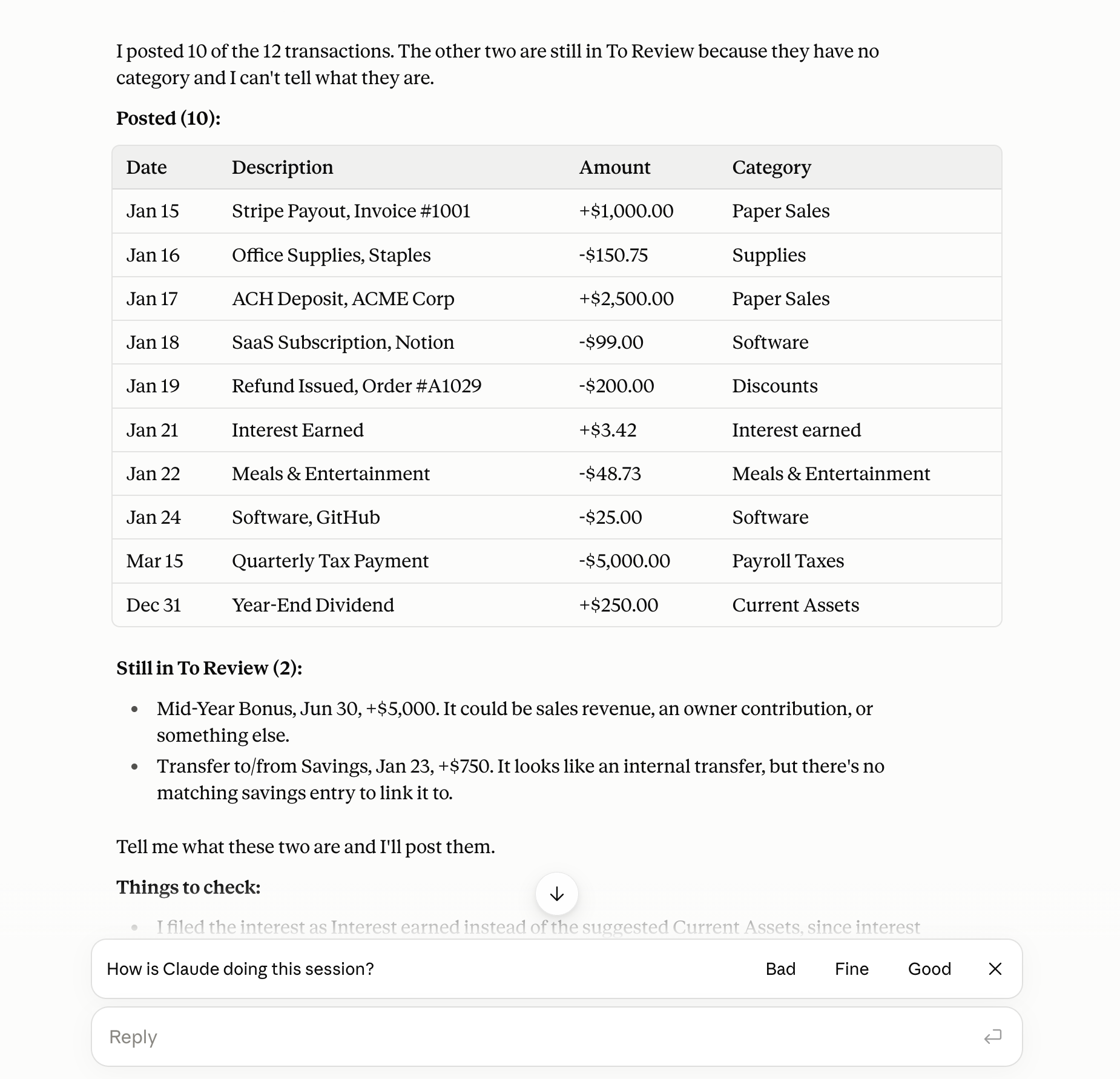
An assistant connected to your ledger. Same chat, but behind it are tools that act on real books: post this row, match these two, book this entry, reconcile this account, run this report. This is what the plugin and connector directories made possible this year. Switchbooks is listed in ChatGPT, Claude, and Grok Bot, and the assistant's memory stops mattering because the ledger holds everything.
An agent inside the bookkeeping software. Same tools, but the assistant lives in the app, sees the page you are on, and shows you a preview before anything big. In Switchbooks that agent is called Elliott.
The second and third are the ones that can honestly say yes to the question in the title. Switchbooks offers both, and they run on the same tools, so "post what is in To Review" does the same thing whether you say it to ChatGPT, Claude, a Grok Bot, or Elliott in the app.
What AI does well
- Categorizing the ordinary 90 percent of transactions, consistently, every day instead of once a quarter.
- Matching transfers between checking, savings, and the cards.
- Making and following rules in plain words. "Home Depot is materials" becomes a rule that runs on every new row.
- Reconciling to a statement from a preview, and telling you exactly what does not tie.
- Running the P&L, balance sheet, and cash flow for any dates, and answering questions about them in plain English.
- Keeping a record of every change it made, so you can undo one.
What still needs a person
- Tax treatment and entity questions. Whether something is deductible, how to structure a second company, what to do about that distribution. That is advice, and it should come from a person who signs their name to it.
- Year-end. A good AI gets the books clean enough that year-end is quick, but someone still reviews them and files the return.
- The first conversation. The AI needs to be told what the business does and how you want things handled. That takes you ten minutes, once.
- Judgment on the unusual. The AI is built to ask when it is unsure. You answer, and it remembers.
What it costs
At my firm, a small business paid a few hundred dollars a month at the low end and well over a thousand a month when the books were busy. That bought a person who knew the business and kept it clean, and for many owners it was worth every dollar.
Switchbooks is $25 per month per company, with every feature included: bank sync, the AI agent, rules, reports, reconciliation, and the connections to ChatGPT, Claude, Grok Bot, and Cursor. There is one plan and a free ten-day trial with no card. Most owners pair it with an accountant for a quarterly look and the tax return, which is a far smaller bill than monthly bookkeeping.
If you own franchises or several locations, run payroll for a real team, and want the whole thing handled by people, a firm is still the right answer. That is what Ledge Accounting does, with US-based CPAs and monthly financials by the 7th. Ledge runs its clients on Switchbooks, so the books are the same either way. The difference is who is driving.
How to try it in fifteen minutes
- Create a free account at switchbooks.ai.
- Connect your bank and credit cards. Switchbooks uses Plaid, the same connection most banking apps use. Connect every account the business uses so transfers have both sides.
- Tell Elliott about the business, the way you would brief a new bookkeeper. What you do, how you get paid, what the main costs are.
- Say "post everything in To Review you are sure about and list the rest." Answer its questions.
- Ask for last month's P&L and the balance sheet. Those are your first real financials.
If you would rather work from the assistant you already use, connect it instead. I wrote simple guides for ChatGPT, Claude, and Grok Bot. Connect read-only first if you like. Once you trust what it reports, allow changes. Every change is recorded and most can be undone from the same chat.
Is it safe?
A connected assistant never sees your bank login. You sign in to your bank on Plaid's own page, and the assistant only sees the transactions that land in the books. You choose read-only or allow changes when you connect. No connected assistant can sign in to your bank, move money, invite or remove people, share a report, or change billing. The details are on the Switchbooks security page.
Read more
- Which AI agents, plugins, and connectors actually do the books, with a six-question test and a video of Claude posting 150 transactions.
- Can ChatGPT do my bookkeeping?
- Can Claude do my bookkeeping?
- Every way to connect an assistant to Switchbooks
- What is Switchbooks? on this site.
Common questions
Can AI do bookkeeping on its own?
Not from a chat window alone. It needs a ledger to post to. Connected to real books through a plugin, a connector, or an agent inside the bookkeeping software, it can categorize and post transactions, match transfers, book journal entries, reconcile accounts, and run reports.
Can ChatGPT do my bookkeeping?
With the Switchbooks plugin, yes. Install it from the ChatGPT plugin directory, sign in to Switchbooks, allow bookkeeping changes, and type @switchbooks in a chat. ChatGPT can then read your books, run reports, post transactions, match transfers, and reconcile.
Can Claude do my bookkeeping?
Yes, through the Switchbooks connector in the Claude directory. Click Connect, sign in to Switchbooks, choose whether Claude may make changes, and turn the connector on in a chat.
Will AI replace my bookkeeper?
It takes over the sorting, matching, and reconciling. Tax advice, entity questions, and the year-end review still belong to a person. The firms using Switchbooks are taking on more clients, not fewer.
How much does AI bookkeeping cost?
Switchbooks is $25 per month per company with every feature and every assistant connection included, and a free ten-day trial with no card. A human bookkeeper typically costs a few hundred to over a thousand dollars a month.
More guides on this site
- ChatGPT bookkeeping plugin: how to use ChatGPT for bookkeeping
- Claude bookkeeping connector: how to use Claude for bookkeeping
- Grok Bot bookkeeping plugin: how to give your Bot the books
- Best ChatGPT plugins for small business
- Best Claude connectors for small business
- Best Grok Bot plugins for small business
- What is Switchbooks?
- What is Ledge Accounting?